Decision gates
Use a richer answer than yes or no.
Classify consequential moves as Stop, Redesign, Proceed, or Accelerate so judgment remains explicit and actionable.

RDS brings evidence, authority, provenance, policy, and trust into the decision itself. It helps Wellzai distinguish between a pathway that should stop, one that needs redesign, one that can proceed, and one that is ready to accelerate.
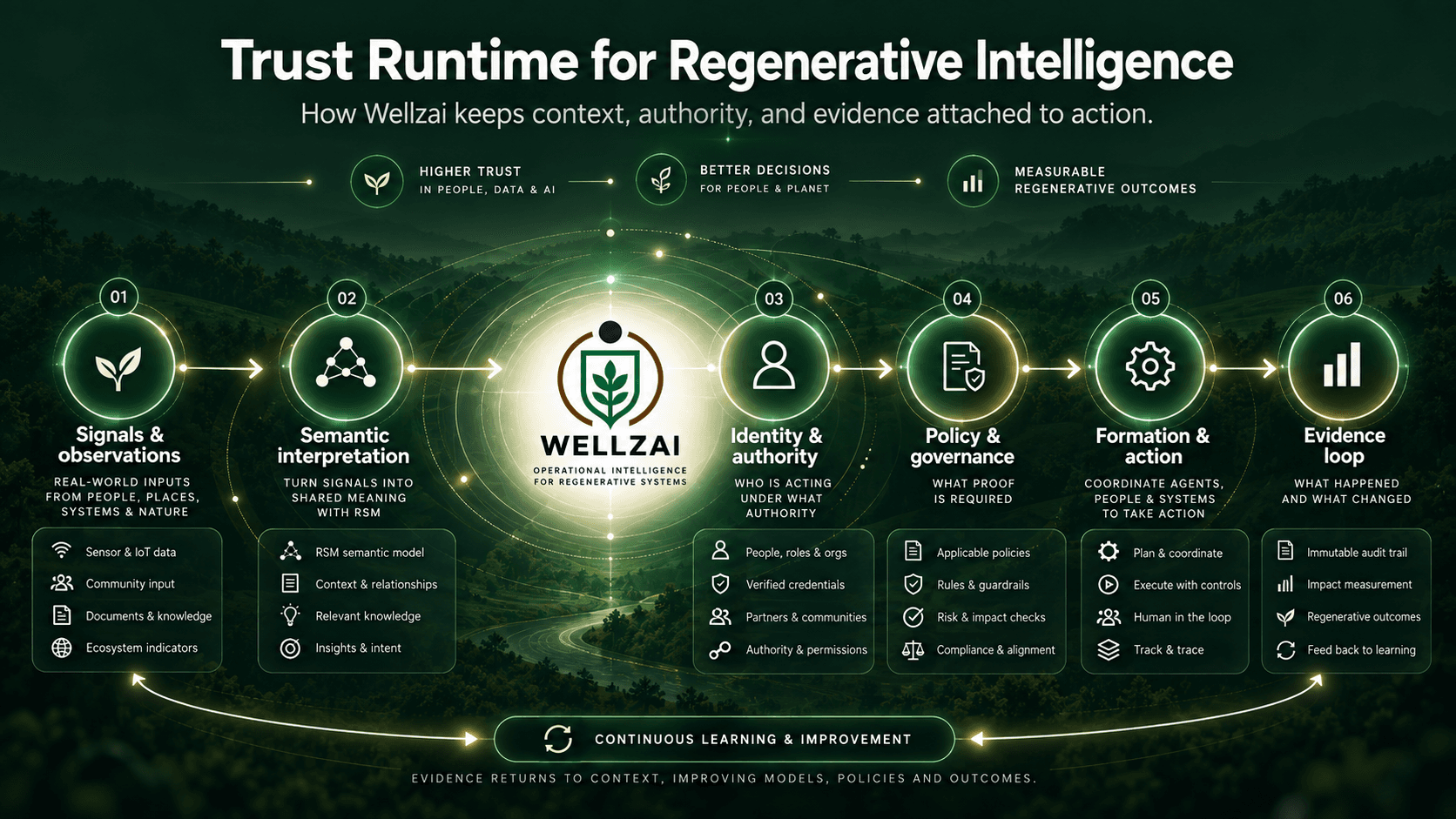
Trust before action
When institutions, capital, or intelligent agents are involved, a recommendation is not enough. RDS is designed to make the basis for action inspectable by keeping identity, evidence, authority, policy, and accountability attached to the move. The trust runtime shown here is the end-state architecture Wellzai is building toward.
Decision gates
Classify consequential moves as Stop, Redesign, Proceed, or Accelerate so judgment remains explicit and actionable.
Proof
Specify the evidence, authority, provenance, alignment, and policy conditions a pathway must satisfy.
Governance
Support enterprise and agentic workflows without separating execution from the trust conditions that make execution legitimate.
Decision gates
As AI agents and automated workflows begin to initiate consequential actions, approval cannot be an afterthought. RDS gives every move an explicit, inspectable state so people, institutions, and intelligent systems share the same basis for acting.
The move should not proceed because the pathway is misaligned, unsupported, or likely to cause harm.
The intention may be sound, but the current structure, evidence, or authority is insufficient.
The pathway is credible enough to move with appropriate stewardship, controls, and monitoring.
The pathway is working and the evidence supports additional support, scale, or replication.
RDS in a formation
See how evidence, constraints, trust, and decision readiness distinguish a merely possible path from a credible one, and why the result is Proceed with conditions rather than a simple approval.
Where it becomes useful